Top
Skip to Content
LOGO(small) - Queen's University Belfast
  • Our facebook
  • Our instagram
  • Our x-twitter
LOGO(large) - Queen's University Belfast

The Seamus Heaney Centre

  • Home
  • About
    • The Centre
    • The Blackbird
    • The Heaney Community
    • Collections at the Seamus Heaney Centre
  • Our People
    • The SHC Fellows
    • Ciaran Carson & Publishing Fellows
    • Children's Writing Fellow
    • Visiting International Poetry Fellows
  • Study
    • The Poetry Summer School
    • Regular Projects
    • Writing Groups
    • Hear from Alumni
    • Trust Your Voice
  • Resources
    • SHC Publications
    • Criticism & Ideas on Writing
    • The SHC Podcast
    • Tiny Masterclasses
  • First Collection Poetry Prize
    • Poetry Prize 2026
    • Poetry Prize 2025
    • Poetry Prize 2024
    • Poetry Prize 2023
    • Poetry Prize 2022
  • Events
    • SHC Presents...
    • Conferences
    • Reading Seamus Heaney
    • Translation
  • News
  • Home
  • About
    • The Centre
    • The Blackbird
    • The Heaney Community
    • Collections at the Seamus Heaney Centre
  • Our People
    • The SHC Fellows
    • Ciaran Carson & Publishing Fellows
    • Children's Writing Fellow
    • Visiting International Poetry Fellows
  • Study
    • The Poetry Summer School
    • Regular Projects
    • Writing Groups
    • Hear from Alumni
    • Trust Your Voice
  • Resources
    • SHC Publications
    • Criticism & Ideas on Writing
    • The SHC Podcast
    • Tiny Masterclasses
  • First Collection Poetry Prize
    • Poetry Prize 2026
    • Poetry Prize 2025
    • Poetry Prize 2024
    • Poetry Prize 2023
    • Poetry Prize 2022
  • Events
    • SHC Presents...
    • Conferences
    • Reading Seamus Heaney
    • Translation
  • News
  • Our facebook
  • Our instagram
  • Our x-twitter
In This Section
  • The Friday Critique
  • Notions
  • The Saturday Matinee
  • The Sunday Spotlight
  • Twelve Picks of Christmas

  • Home
  • Seamus Heaney Centre
  • Resources
  • Criticism & Ideas on Writing
  • Twelve Picks of Christmas

Twelve Picks of Christmas
Staff Picks 2025

Wondering what the staff at The Seamus Heaney Centre enjoyed this year? Look no further than our exciting staff picks of 2025!

Each member of our staff works hard all year round, now it's time to celebrate another successful year by choosing our favourites. This can be a film, or a theatre production, a book or a poetry collection. Just something that made us think, feel and be inspired! 

2025 has been a BIG year for new writing, but it's also been an incredible year for us here at The Seamus Heaney Centre. With PHD success, to the publication of multiple students and staff, and the addition of more events and workshops. It's safe to say this has been a wonderful year! 

Enjoy our picks of 2025! 

Follow us for regular reviews!
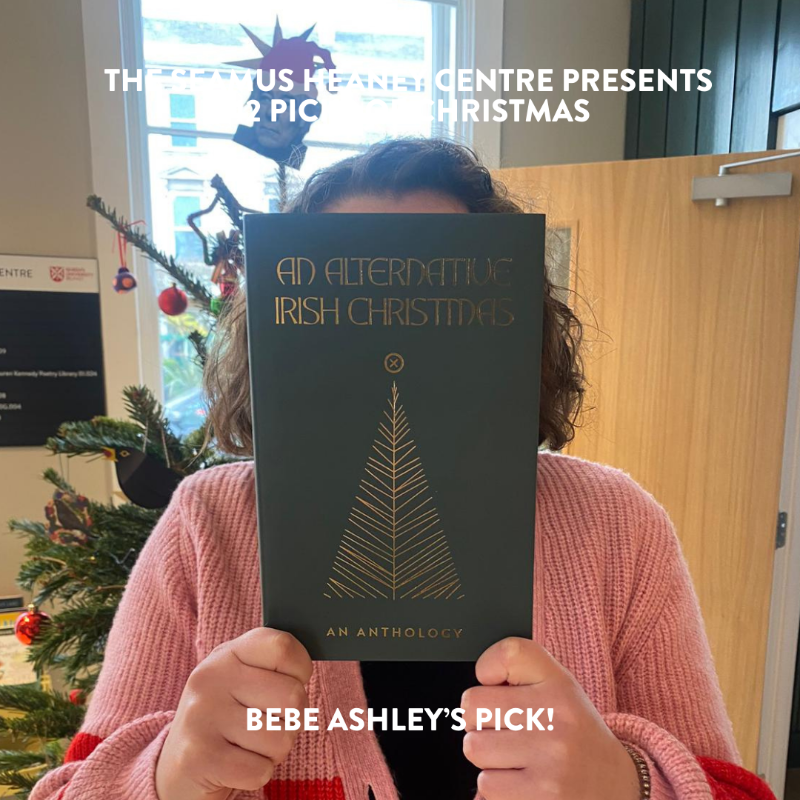
Bebe Ashley's 2025 Pick!
An Alternative Irish Christmas (Tramp Press)

If you are ready to embrace the chaos and catastrophe that Christmas can bring to family, friends, and future ambitions, then An Alternative Irish Christmas is an excellent addition to your winter bookshelf. 

With short stories and essays from writers across Ireland working in a breadth of styles and genres, dipping into An Alternative Irish Christmas is much like helping yourself to another plate at the Christmas Eve Buffet. Just one more plate of literature, please. I’m still thinking about how good that last story tasted. I’ll have another, and if nobody else is going to finish it off, then I’ll give it a go. It is all quite enjoyable until you are betrayed by the buffet hiding heartbreak and good endings between the condiments. A Christmas walk it’ll be then, to harbour resentment for all the truths between the pages, and how well they were written. 

As you turn the page, and tell yourself you’ll rejoin the social festivities shortly, this anthology has a protective function too. There is no such thing as the perfect Christmas, and this collection reminds us that we might be foolish to plan for such. There are few experiences that make me feel more human than Christmas does, but reading An Alternative Irish Christmas, did just that. After the weeks of consumerism and buying one present for someone else, alongside one present for me too, I felt human again.

Read more Read less

Bebe Ashley's 2025 Pick!
An Alternative Irish Christmas (Tramp Press)

If you are ready to embrace the chaos and catastrophe that Christmas can bring to family, friends, and future ambitions, then An Alternative Irish Christmas is an excellent addition to your winter bookshelf. 

With short stories and essays from writers across Ireland working in a breadth of styles and genres, dipping into An Alternative Irish Christmas is much like helping yourself to another plate at the Christmas Eve Buffet. Just one more plate of literature, please. I’m still thinking about how good that last story tasted. I’ll have another, and if nobody else is going to finish it off, then I’ll give it a go. It is all quite enjoyable until you are betrayed by the buffet hiding heartbreak and good endings between the condiments. A Christmas walk it’ll be then, to harbour resentment for all the truths between the pages, and how well they were written. 

As you turn the page, and tell yourself you’ll rejoin the social festivities shortly, this anthology has a protective function too. There is no such thing as the perfect Christmas, and this collection reminds us that we might be foolish to plan for such. There are few experiences that make me feel more human than Christmas does, but reading An Alternative Irish Christmas, did just that. After the weeks of consumerism and buying one present for someone else, alongside one present for me too, I felt human again.

Read more Read less

Ida Boardman's 2025 Pick!
Heartburn, by Nora Ephron

After a couple of months of harassing my landlord, my GP, and a rather unhealthy dose of mould poisoning, I had thought about recommending Goodlord by Ella Frears or I Want to Go Home but I’m Already There by Róisín Lanigan. Whilst I admire how both these books portray the appalling state of the rental market, and the uniquely unpleasant experience of being a young women, they didn’t seem very festive.

The book I decided upon won’t sound much cheerier but I promise you, it is far more hopeful than its plot summary suggests. Heartburn by Nora Ephron follows the fallout of Rachel Samstat, a food writer, discovering that her husband Mark Feldman, a political journalist, had an affair with a mutual acquaintance while Rachel was seven months pregnant with the couple’s second child.

Despite coming out over forty years ago, Heartburn still feels as relevant and applicable as ever – please consider Lily Allen’s new album about the misdeeds of David Harbour, or the world of Wicked where Ethan Slater left his wife shortly after the birth of their first child. Wages may have stagnated and house prices may have soared, but men abandoning their wives in wildly inappropriate circumstances remains a steadfast tradition.

A huge part of the novel’s enduring appeal is Ephron’s narrative voice. She writes with a familiarity that feels conspiratorial, as if she’s not just your closest friend but someone who’s taken up residence inside your head. The pain underlies her humour, which is still as fresh and striking as a paper cut. The language is pared back but always astute in its observation. It is written with great emotional honesty which verges on bluntness but doesn’t feel hard-hearted, rather it leaves you feeling armoured against the world.

I read Heartburn during the worst of the mould poisoning and whilst it was primarily the antibiotics, steroids and inhalers that made me feel better, Nora Ephron certainly helped. There is something really comforting about how Ephron created such a sense of hope from the most unlikely of circumstances and offered a reminder that life will always go on.

Read more Read less

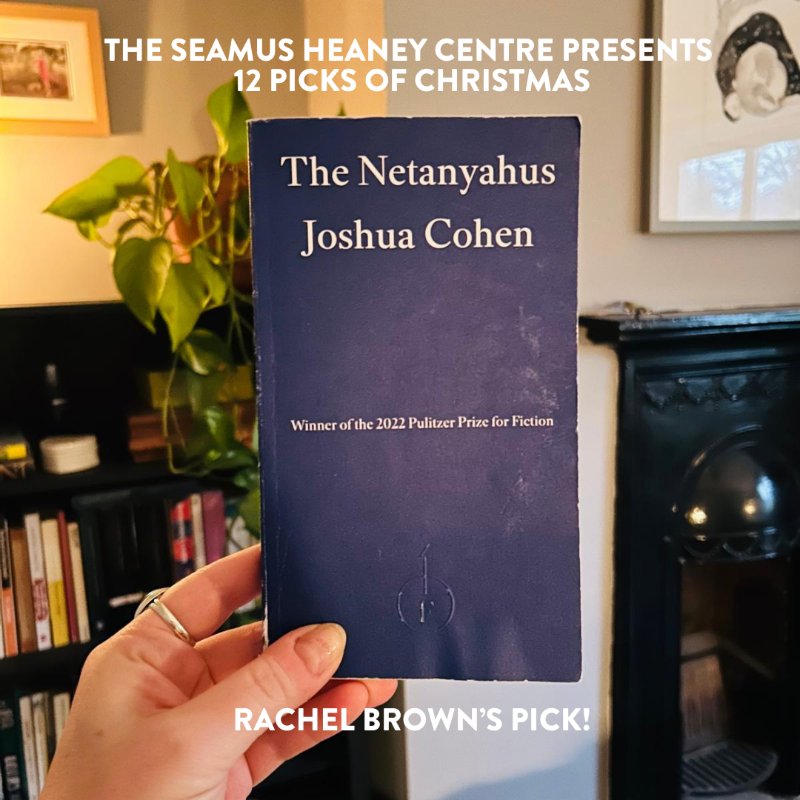
Rachel Brown's 2025 Pick!
The Netanyahus, by Joel Cohen

This autumn, I very much enjoyed losing my mind in Shadow Ticket, Thomas Pynchon’s first novel in over a decade (“Hicks could point out that keeping still and listening to a story isn’t the same thing as falling for it, but sees no reason to start an argument.”) However the book I’ve recommended over and over this year is The Netanyahus by Joel Cohen, published in 2021 and winning the Pulitzer in 2022.

As the subtitle says, it is ‘An Account of a Minor and Ultimately Even Negligible Episode in the History of a Very Famous Family’ and the story hinges on the real experiences of literary critic Harold Bloom meeting Benzion Netanyahu - key figure in the revisionist Zionism movement and father of Benjamin - as a visiting professor in America in the 1950s. I read it earlier this year with the backdrop of the real Netanyahu junior justifying atrocities, attempting to rewrite history in plain sight.
The Netanyahus is a deeply dark satirical campus novel, with whole chapters in the form of history lectures, positioning the central farce in relation to the origins of the state of Israel. With everything it’s doing, it could be a mess but it accommodates the chaos with pitch perfect tone, and an honesty you can only find sometimes in fiction.
Read more Read less

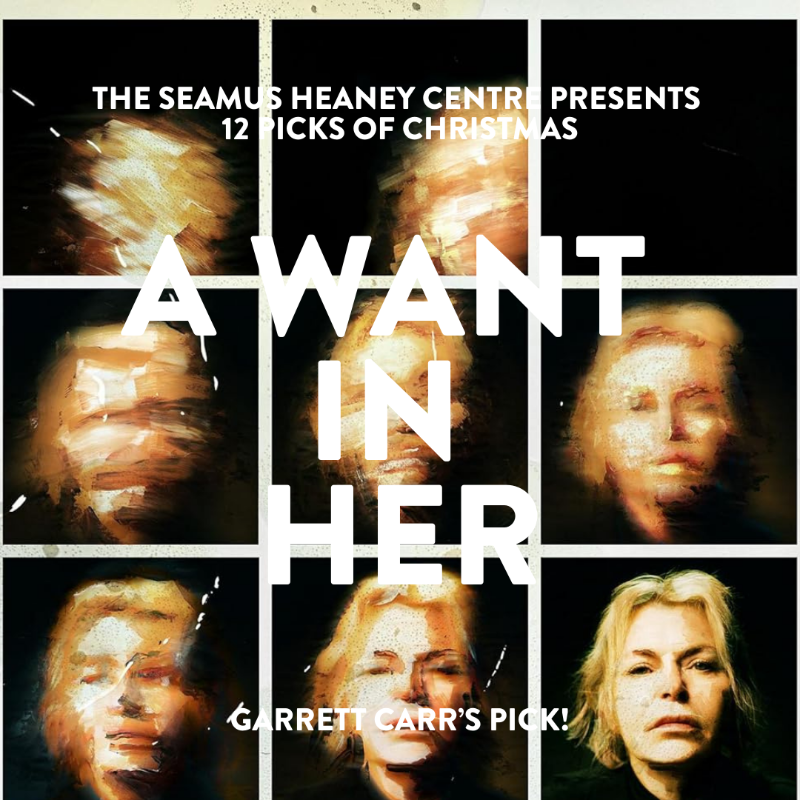
Garrett Carr's 2025 Pick!
A Want In Her

A Want in Her is a feature-length documentary in which Myrid Carten records her mother’s alcoholism and its impact on her and the wider family.

It is filmed mostly in Donegal and draws together old and new footage. Myrid captures the Donegal I recognise: softly spoken men with keen turns of phrase; open fires; decaying houses; undiagnosed mental health issues and always a hauntedness hanging in the air.
Myrid’s films are more usually short, made to be viewed in gallery spaces, and she deploys artful experimentalism in this documentary too. Members of her family collude in moments that are choregraphed but never false. The audience is aware of what is going on, understand its ultimate authenticity, and are swept up.
It seems Myrid is constantly filming and her family (almost) never object. Even though the relationships are fraught and loaded with old trauma the willingness of Myrid’s mother, uncles and cousins to help her produce the film shines through at every moment.
Due to this, and despite the pain, the abiding impression left by the documentary is one of love.
Read more Read less

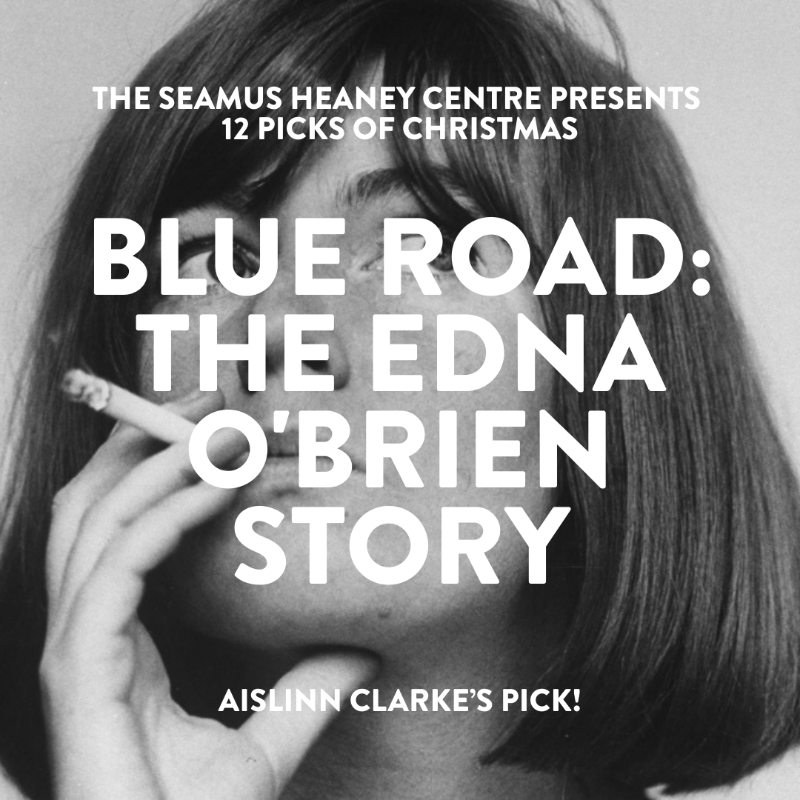
Aislinn Clarke's 2025 Pick!
Blue Road: The Edna O'Brien Story

Sinead O’Shea’s The Blue Road: The Edna O’Brien Story pays attention. It watches. It waits. It listens.

O’Brien is in her nineties, and every word feels deliberate, every pause freighted with history. She was never quiet, never small. Ireland tried to contain her, to label her novels obscene, to murmur about her audacity at dinner parties. And yet here she is, speaking plainly, revealing what audacity looks like in its final form. She was ballsy - and the film does not shy away from it.
Filmed not long before O’Brien's death, O’Shea captures a rare convergence: the immediacy of the living voice, the accumulated weight of decades of observation, and the clarity of a mind still unafraid. These sequences feel less like formal interviews than the final articulations of a mind fully alert to its imaginative obligations. When challenged in archival footage on accusations that she exploited Ireland - its history, its traumas, its women - O’Brien responds with characteristic candour:
“I take from the fund of history and geography and stories and I make out of it my own song. It’s a form of stealing, but it’s like a bank loan: you have to give it back.”
The remark frames her work as both daring and accountable - a lifelong negotiation with Ireland, and, more importantly, the world.
O’Shea animates this “song” through a deft interlacing of archival material, personal writings, and diary readings by Jessie Buckley. The effect is not nostalgia; it is unflinching clarity. O’Brien emerges fully herself, fully awake. What she gave back is nothing less than a vision of Irish womanhood as morally and imaginatively capacious. She embodies a refusal to be diminished, an insistence on witnessing and shaping her world with rigour.
Read more Read less

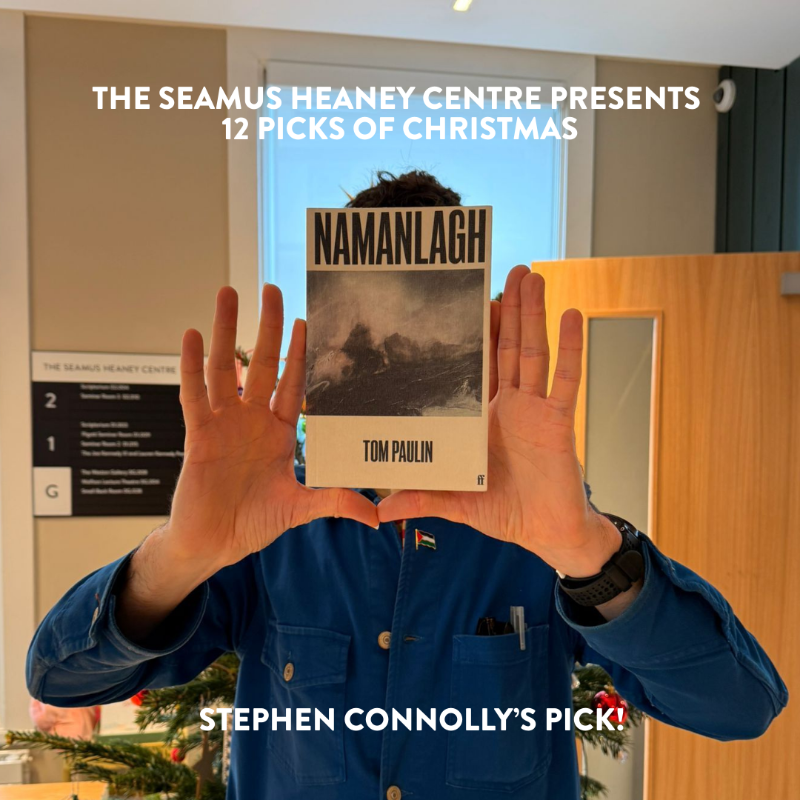
Stephen Connolly's 2025 Pick!
Namanlagh, by Tom Paulin

To begin in the same way that everyone talking about this book does: it’s been more than a decade since Tom Paulin’s last book of poems. But when I think about it, the unforced and quiet beauty of the poems in this book would suggest that this kind of extended interim is not such a remarkable thing.

When Michael Hofmann was a Fellow at the Centre, he asked me if Tom Paulin is read much by my contemporaries and I had to admit that I didn’t really know. He has always been an outlier in my mind, at a remove from the Well Wrought Urn poems by poets of a similar generation from the North. I’ve always loved his poems, but probably couldn’t articulate why.
‘Somewhere in the pine trees beyond the lough/ two stones are being knocked together’ is how the opening (title) poem of Namanlagh begins, and what follows—through the poem and through the book—might be described as the outworkings of a spiky and curious mind that belies his decades of writing, thinking and his erstwhile public life.
Historically contested spaces (Drumcree, Ormeau Road) and borderlands both real (Pettigo, ‘The Road to Lifford’) and metaphorical (‘Edge of Town’ and ‘After Depression?’) account for a considerable amount of the book’s subject matter, as do poems of war (both recent and not-so-recent, both local and not-so-local). I love the shapes his mind makes when turned to these subjects.
More than this, I love the refracted patterns of sound his lines make, his associative logic and how he might be a perfect example of that type of ambiguity that involves the writer finding their idea in the act of writing.
Read more Read less

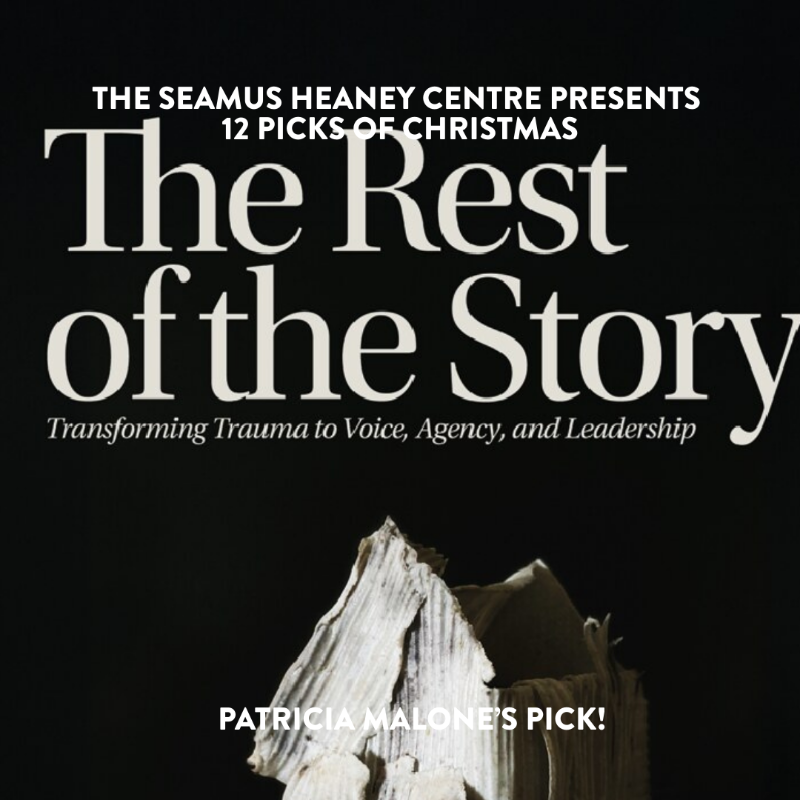
Patricia Malone's 2025 Pick!
The Rest of The Story: Transforming trauma to voice, agency and leadership

There is a truism in the teaching of creative writing that it’s all about finding your voice.

For some, that’s an exercise in style; for others, it means finding way to put down on the page thoughts, feelings, and experiences that have long dwelt in the realm of the unutterable.  
I’ve spent years studying and teaching literature, taking it apart and repackaging it according to the requirements of twelve-week courses and learning outcomes. I started to read extractively: to get the ‘meaning’ out of a book or figure out how it could be useful in framing an argument or illustrating a certain concept.  
But when I first started reading, when I was wee, it was because books were a portal. I could see another world in them. I could hear voices speaking to me. I went to the South of France and saw Nicole Diver’s pearls hanging down her tanned back. I stole power with the Invisible Man. I fretted that pride and prejudice would derail romance. I lived whole lives in books. 
I’ve been learning to read again this year, learning to let books in. Not to rush, not to hurry, not to will the point to make itself plain. Just to look at the words on the page and live in their world again.  
I read the Rest of the Story and the voices there sang off the page. I went into all these different worlds, some I recognised, some I didn’t. I found myself crying on the 12B. Laughing at fermented ham soup. Peeking into rooms I’ll never get to walk though. I heard all these voices like they were right in my ear, and I was reminded that every story does matter. That's a truism too but fuck it. It’s true. 
Read more Read less

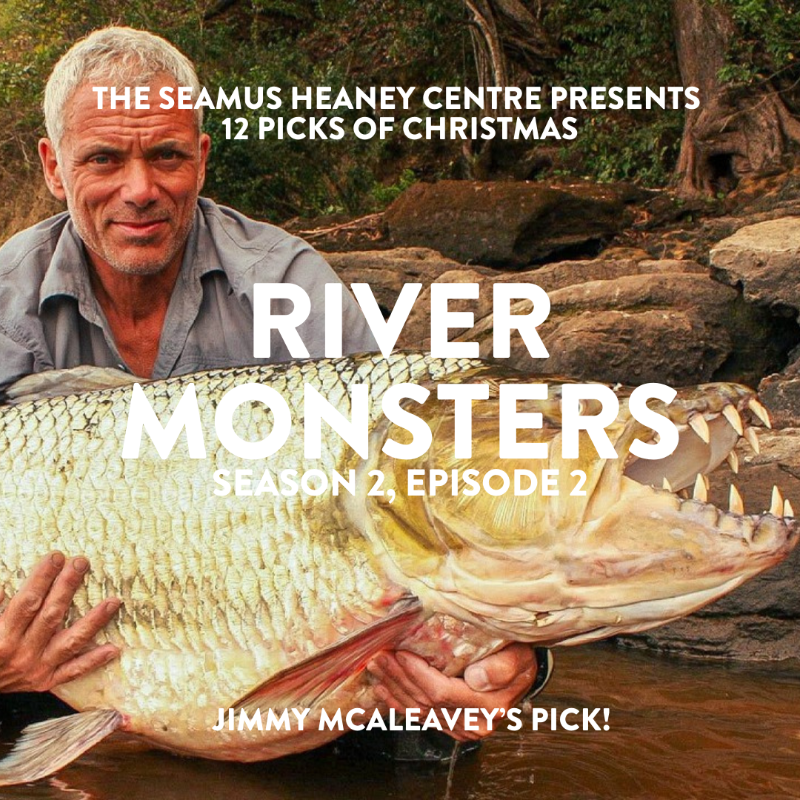
Jimmy McAleavey's 2025 Pick!
River Monsters, Season 2, Episode 2

Sometimes I can’t sleep so I lie on the sofa, bobbing on the surface between the two worlds, and watch River Monsters. 

Jeremy Wade, ‘explorer and extreme angler’, is near 70 now – lean, white-haired, bleached and tide-marked, looking like a length of knotted mono-filament.  His pursuit of monstrous and sometimes unknown fish predates the TV show – they just follow him around while he stands like a stork in the Mekong in the middle of a thunderstorm, lightning playing about his rod tip, or hunched over in a boat trying to budge a giant stingray that has clamped itself to the Amazon riverbed, like trying to pull the plug out of the sea.  (When he finally beaches it, it is obscene, a cross between an enormous rubber shower mat and a filthy puddle.  He offers it a raw leg of pork, which it spears with a sting covered in necrotic venom.  It’s the way it does it, curling first to get all its weight behind the strike.  With malice.)

This time he’s after a Goliath Tigerfish in ‘the most inaccessible part of the most inaccessible river on earth’: the Congo.  A girl playing in the water has disappeared, a man standing up in boat has been killed by a fish that leapt out of the water and bit him in the throat.  Such is the Grimm’s fairytale nature of the format.  Jeremy will hunt the monster, catch it and… study it.

He’s been in Botswana for weeks now, fishing every hour.  Three times he’s hooked something big and strong and fast; three times it has spat out his treble hooks and wire trace ‘with contempt’.  He begins to wonder if this thing is real or mythological.

Jeremy goes to see the ‘féticheur’, priest of the area, who performs rites and gives him a charm both to catch the fish and protect him from it.  Normally you’d be worried about the white gaze here but Jeremy just wants to catch the thing and every angler is a shaman anyway, standing on the boundary of two worlds with a twitching wand.

The very next day he gets into one and manages to pull this thing out -- out of the Pleistocene, out of Ted Hughes’s unconscious, an aquatic Nosferatu out of Death’s nightmares.  Fred, Jeremy’s boatman for the past weeks, gets a rope around its tail and they lift it up.  It’s like a piranha the size of a rottweiler and you can’t take your eyes off its fangs; yellow, six inches long and gnawing the air with hatred.  Jeremy needs to hold it up in the shallows until it has recovered from the fight; in this state if he lets it go it’ll get bashed against the rocks.  But, if it recovers fully, it could take his arm off.

Fred asks him when he’s going to kill it.  Jeremy says he doesn’t do that.  Fred says it was given by god, with the help of the féticheur, with the help of the people of the nearby village.  They all should have some of its flesh.  It would make them happy, Fred says.  He’s being diplomatic.  But it’s agonising for Jeremy; he’s a westerner who studies fish, not someone who feeds themselves from the river.

They stand there, holding it, Fred looking in the opposite direction now.  Then the strangest thing happens.  It turns on its side and dies.  Jeremy is left holding the brute fact of this dead fish.

He hoists it onto his shoulder and carries it into the village.  People come out and cheer – most of them have never seen one but they’ve certainly heard of it.  They slap the fish’s sides, take it from him and hold it aloft.  It ends with one of the villagers working the double hinge of its jaw, the dead fish still gnashing as the shot creeps in.  I’m scared to go to sleep now.

Read more Read less

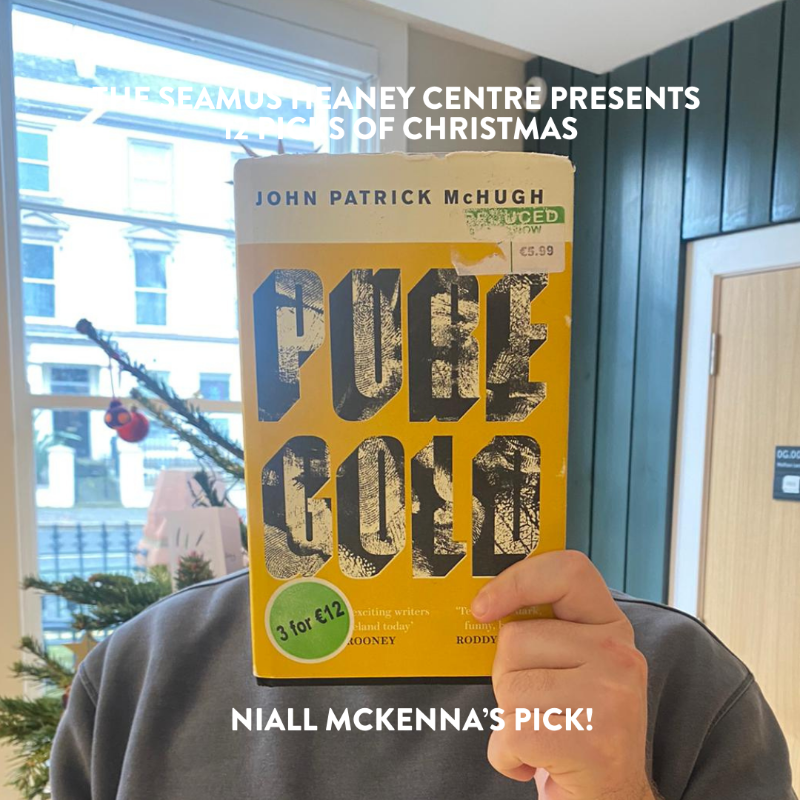
Niall McKenna's 2025 Pick!
Pure Gold, By John Patrick McHugh

A busy 2025 meant a year of short stories; my favourite collection was John Patrick McHugh’s Pure Gold.

Pure Gold is set on a small island off the west coast of Ireland. Lives here brim, the prose bristles, and for the first time in a long time I could not put a book down. ‘A tractor spurted black smog like a trumpet’, ‘her throat glued itself shut’. Not blunt bullion then but filigree, the country spun anew in strange fine strands. I was beguiled, and left vulnerable to repeated emotional jackknifes. Stand on this island, says McHugh, look in any direction, and see tragedy. There’s the boy building a bonfire who cannot burn away his mother’s illness, there’s the dog doomed to be a totem of bereavement. And don’t get me started on the horse. 
To say anything on the premise of my favourite story, the ambitious Howya Horse, would be to spoil it. Suffice to say the narrative unspools, head by head, and as each perspective unfolds they overlay and reveal each other in a new light. Character’s interiors deepen like halls of mirrors, like you could walk through their infinite space forever. So much room for a character to perform mental gymnastics, to absolve themselves of an abhorrent crime, and room still for us to pity them. 
There’s no story here that did not move me. Hoarfrost presents one of the most uncomfortable and wounding soirees I have ever encountered (on paper), and Twelve Pubs will resonate with anyone reconnecting with bastards this Christmas. Bastards everywhere, in Pure Gold, cruel bastards whose cruelty is not quite redeemed but momentarily leavened by yearning. 
It’s the barriers that stand out - the sea, the doubt, the pain. People pushing against their confines, questing for connection, sometimes finding it, more than often not. That this can be such a riot speaks to McHugh’s breadth and skill as a writer, and I look forward to reading his novel Fun and Games this Christmas.
Read more Read less

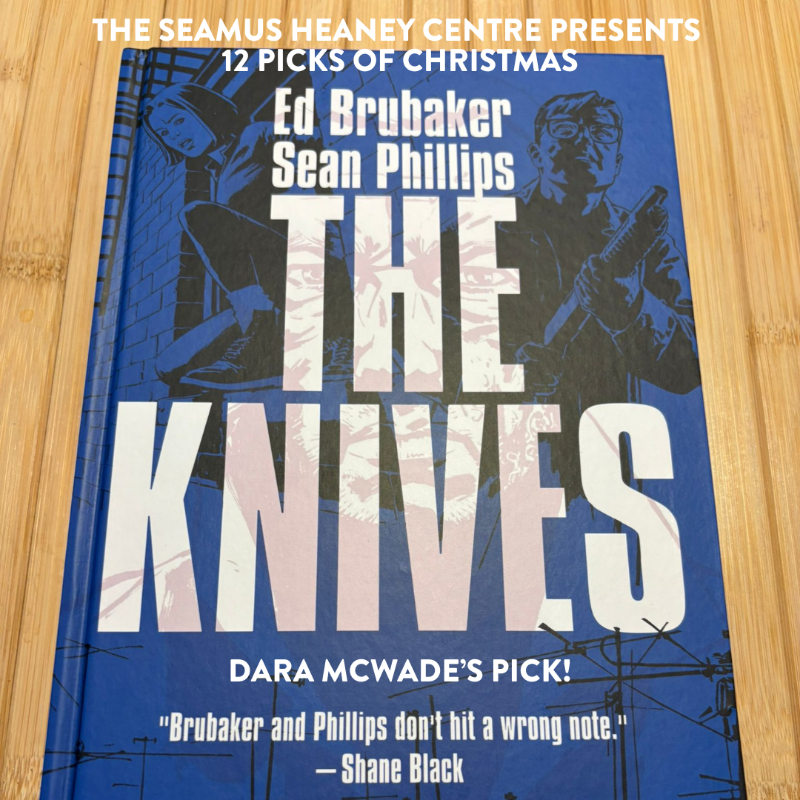
Dara McWade's 2025 Pick!
Criminal: The Knives, Ed Brubaker and Sean Philips

I seem to have taken on the reputation of ‘comics guy’ here at the SHC, so in order to further cement that reputation, and argue for a medium oft-underlooked — I am here to endorse Ed Brubaker and Sean Phillip’s excellent series of stark, pulpy crime noirs, Criminal

Reading 10 of the 11 Criminal volumes in one capacious gulp was simply the purest pleasure I had in reading this year. These comics are exactly what you want from a series called Criminal; clockwork plots, dynamic if broad characters — think names like ‘Tracy Lawless’ — and a large underworld’s whose shared history blooms through each progressive volume, despite each being enjoyable and digestible as a standalone caper.

Their most recent volume, this year’s The Knives, follows four of the series’ best characters in an interconnected series of stories. My favourite of these involve a cat burglar repeatedly breaking into the apartment of the city’s major crime boss not to steal anything, but to prank him.

Amazon Prime have an adaptation ready to release for an early binge next year — but do yourself a favour, and pick up at least one comic first. Satisfaction awaits. 

Read more Read less

Sam Thompson's 2025 Pick!
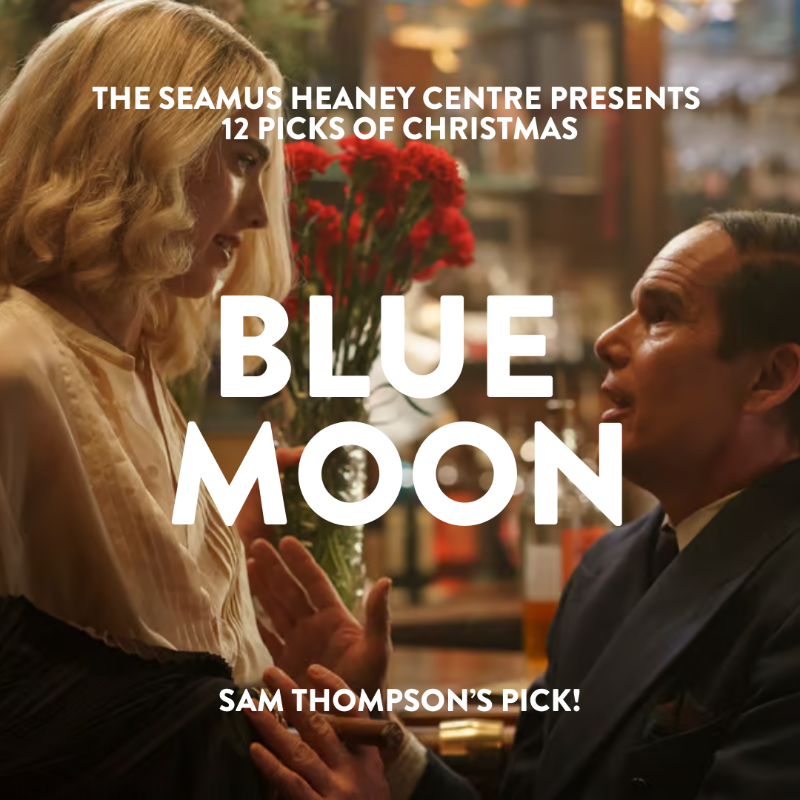
Blue Moon

My pick is Richard Linklater's new film Blue Moon, in which Ethan Hawke plays the great American lyricist Lorenz Hart. 

One night in 1943, Hart is in the audience for the Broadway premiere of the musical Oklahoma!, which his former songwriting partner Richard Rodgers has created with a new partner, Oscar Hammerstein. Hart hates Oklahoma! so much, and is so galled by the fact that it's clearly going to be a huge success, that he slips out to Sardi's Restaurant and spends the rest of the film in the bar, brooding on his professional and personal disasters while having witty, wistful, self-deceiving conversations with the bartender, the pianist and other Manhattanites.
 
Three of my favourite films are Linklater's Before Sunrise, Before Sunset and Before Midnight. Like the Before films, Blue Moon unfolds almost entirely in real time, and in some ways feels loosely structured, moving easily along with the flow of conversation and of theatregoers in and out of the bar; but that looseness is most artful, and coaxes us into real intimacy with the characters. Hawke plays Hart as a brilliant writer losing his struggles with alcoholism, mental ill health, his sexuality, his sense of failure and humiliation: he knows he has written songs that will live forever, but what good has it done him? Andrew Scott as Rodgers and Margaret Qualley as the art student Elizabeth Weiland are excellent as friends who love Hart genuinely, but not enough. Hart quotes Rick in Casablanca -- 'Nobody ever loved me that much' -- and asks: 'Really, who's ever been loved enough?'
Read more Read less

Darcey Youngman's 2025 Pick!
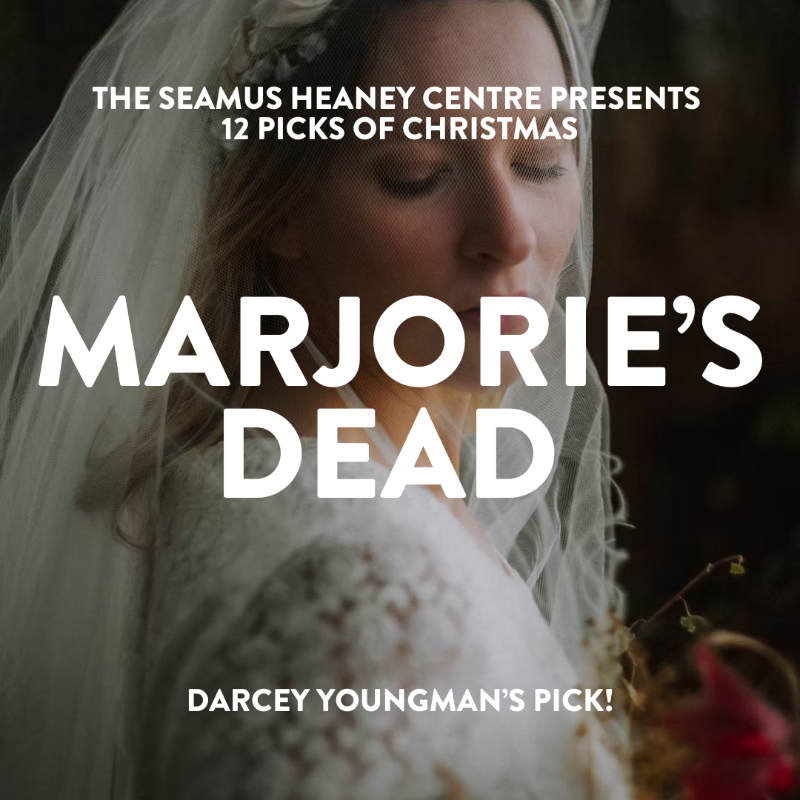
Marjorie's Dead, Dark Forest Theatre

It’s safe to say, and maybe an understatement that Theatre is facing more challenges than it ever did. I won’t name them, as it would depress us all, yet what brings us hope and joy is when we see success, when we see someone defeat the odds. For me, this year’s hope was Dark Forest Theatre’s ‘Marjorie's Dead,’

It told the story of a woman, Marjorie, who imagined herself in Irish mythology to rid of her oppressive reality. 

When I walked in, I felt immersed in the world of the play. What was so brilliant about this particular piece was the use of space. Actors greeted us at the door, leading us to our seats, and they came up the stairs, breaking the fourth wall and spoke to us, the audience. It was creative and unafraid to break conventions. 

It worked smart. The set design, the costumes. The whole play truly showed what theatre makers can do. And that in my eyes, is what theatre should be about. It isn’t about costly sets, or large Proscenium arch. It isn’t about traditionalism and going with ‘safe’ options. It’s about taking risks, telling stories that need to be told, and indeed creating something brilliant.

This production reminded me what it’s all about. Theatre isn’t set in stone, theatre is like Marjorie’s fate, it’s all about taking hold of your own narrative.  

Read more Read less

If in doubt
Give them books!

It's more important than ever to support those champions of new writing, the small presses and booksellers. Read on, for links to buy all our recommendations, and lots more great new writing. 

An Irish Alternative Christmas, Tramp Press

Heartburn, Nora Ephron, Alfred A.Knopf

Namanlagh, Tom Pauline, Faber & Faber 

The Rest of the Story: Transforming Trauma to Voice, Agency, and Leadership, PPR

Pure Gold, A Short Story Collection, John Patrick McHugh, 4th Estate 


Ida's Pick! 2024
Orlando, My Political Biography

"Paul B. Preciado’s 2023 Orlando, My Political Biography uses Virginia Woolf’s 1928 novel, Orlando: A Biography, as a skeleton to bring together 26 contemporary trans and non-binary actors, aged 8 to 70, to share the titular role of Orlando in an experimental work of literary, political and personal commentary.

Throughout the film, Orlandos enter and exit, introducing themselves to the camera, talking about their lives and playing out scenes from the novel, sometimes updated to reflect upon contemporary experience, as their words mingle with Woolf’s. Preciado’s film highlights the ways in which Orlando’s story, whilst written nearly a century ago, speaks to the experience of contemporary trans and non-binary life." 


Niall's Pick! 2024
Venomous Lumpsucker, By Ned Beauman

Venomous Lumpsucker might be one of the bleakest books I have ever read, let alone this year. In this short speculative novel Ned Beauman imagines the endgame of mass extinction and the absurd lengths we might go to avoid reckoning with that nightmare; Ho Ho Horrifying. 

It is also one of the funniest, playing out like one long dark joke. What do you get when you cross a marine biologist, a broker, and a globetrotting adventure to find the most intelligent fish on the planet? An absolute riot. 
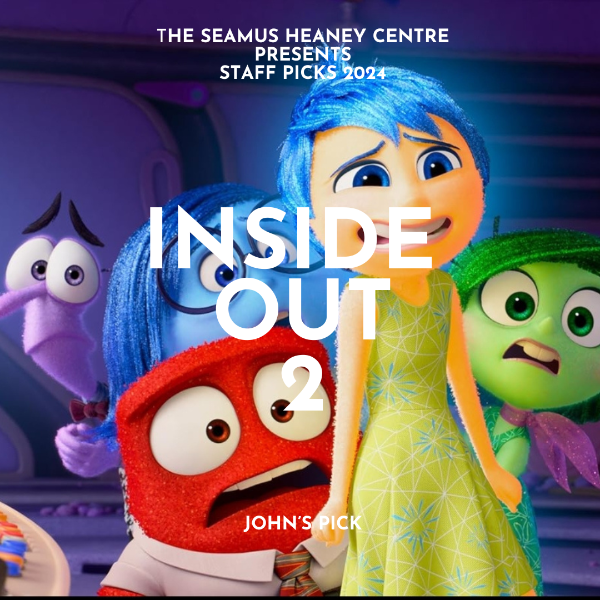

John's Pick! 2024
Inside Out 2

My pick of the year is "Inside Out 2". Taking my daughter to see "Inside Out 2" in the cinema was a big event for both of us. The original is a family favourite and the sequel boldly expands the cast of emotions, adds complexity and beauty to the hero's inner world, and opened up important conversations between us about the inevitability of change in our lives and relationship. It made the big bad future feel a little less scary. 

Dara's Pick! 2024
Why Don't You Love Me, by Paul B. Rainey

Paul B. Rainey’s Why Don’t You Love Me seems, at first glance, to be completely miserable. And, to be clear, it is often miserable.

We open on a seemingly mundane nightmare, following a catatonically depressed mother and a harried, regretful father raising two children in a shabby British house. She is often cruel to her family. Each page opens as it would on a black-and-white newspaper comic the book imitates, with the repetition of the title ‘Why Don’t You Love Me?’. This acts as a punchline for the first half of the collection, landing home moments of brutal bleak comedy. Then Rainey starts to answer that question, in unexpectedly sly, funny, moving and existentially challenging ways. As the comic moves in entirely new ways, our understanding of the narrative shatters, near completely. Rainey asks; how do normal people reckon with the loss of everything that matters? How can we love despite everything? 
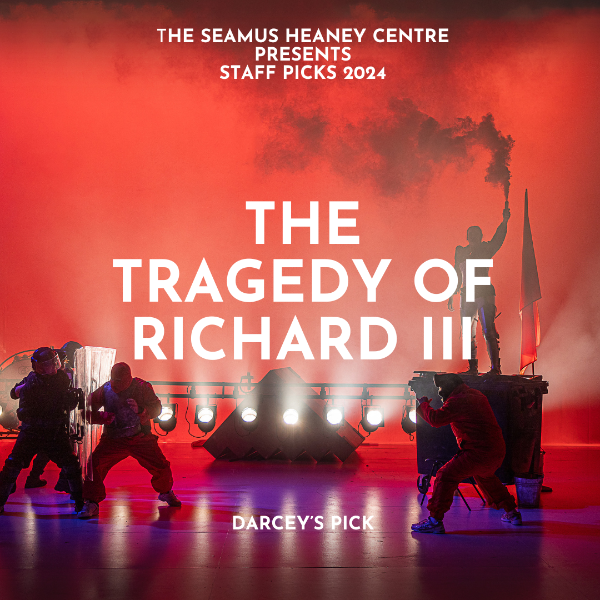

Darcey's Pick! 2024
The Tragedy of Richard III

The Tragedy of Richard III was a spectacle in the eyes and the mind. A tale so familiar, repetitive and true, yet this production brought real life to the story, and experimented with the characters, the design and the message.  

Reflecting on the year, one of my standout moments has to be witnessing the ending scenes of the Tragedy of Richard III. The lighting design and set, an effective and legendary fighting sequence that I will truly never forget. The show itself was a comedic and inclusive re-telling of the classical Shakespearean tale. With stand-out performances from the entire cast, this show wasn’t one to miss; it was nice to see the Theatre so full! 


Criticism & Ideas on Writing
  • Criticism & Ideas on Writing
  • The Friday Critique
  • Notions
  • The Saturday Matinee
  • The Sunday Spotlight
  • Twelve Picks of Christmas
QUB Logo
Contact Us

Seamus Heaney Centre
38-40 University Road, Belfast
BT7 1NN

GET DIRECTIONS

Phone: 028 9097 1077
Email: shc@qub.ac.uk 

Quick Links

  • Home
  • Study
  • People
  • Literary Belfast
  • News
  • Events

© Queen's University Belfast 2024
  • Privacy and cookies
  • Website accessibility
  • Freedom of information
  • Modern slavery statement
  • Equality, Diversity and Inclusion
  • University Policies and Procedures
Information
  • Privacy and cookies
  • Website accessibility
  • Freedom of information
  • Modern slavery statement
  • Equality, Diversity and Inclusion
  • University Policies and Procedures

© Queen's University Belfast 2024

Manage cookies